
Southwest Florida Youth Release Outcomes
The Florida Department of Juvenile Justice describes this center as secure detention for youth awaiting adjudication, disposition, or placement. Adjudication is the juvenile court's decision on the case. Disposition is the court's order about what happens next. A youth may return to a parent or guardian, move into a court-ordered placement, or enter juvenile probation and aftercare. These are distinct outcomes.
Adult SmartWEB released-only results and FDC offender records do not establish a youth's release. Florida Statutes section 985.04 generally makes juvenile information confidential, subject to limited exceptions. A public no-result therefore says nothing dependable about current location or release. Authorized family members, counsel, and other permitted parties should use DJJ and juvenile court procedures.
| Possible outcome | Correct follow-up |
|---|---|
| Return to guardian | Confirm through authorized DJJ or court contact |
| Court placement | Use the placement and court case channels |
| Probation or aftercare | Contact the Glades DJJ program |
Confirm Southwest Florida Youth Release
Begin with the case and the requester’s legal right to receive information. Contact the center or the responsible DJJ program, provide the youth's identifying information, and explain the relationship or authority. Staff may require identity checks or decline public disclosure. That limit protects a confidential juvenile record and should not be bypassed through adult databases.
- Identify the youth and relevant Glades County juvenile case.
- Contact DJJ or authorized counsel rather than the adult jail.
- Ask whether the outcome was guardian release, placement, probation, or aftercare.
- Use the juvenile court channel for an order or disposition available to the requester.
- Follow any stated confidentiality and identity-verification steps.
Southwest Florida Youth Release Contact
The official DJJ facility page identifies the operator, service area, and contact information. It is the sound starting point for an authorized inquiry. The center is in Fort Myers but expressly serves Glades, Lee, Hendry, and Charlotte counties.
2525 Ortiz Avenue
Fort Myers, FL 33905
Phone: 239-332-6927
Operator: Florida Department of Juvenile Justice
The official facility source is shown below.
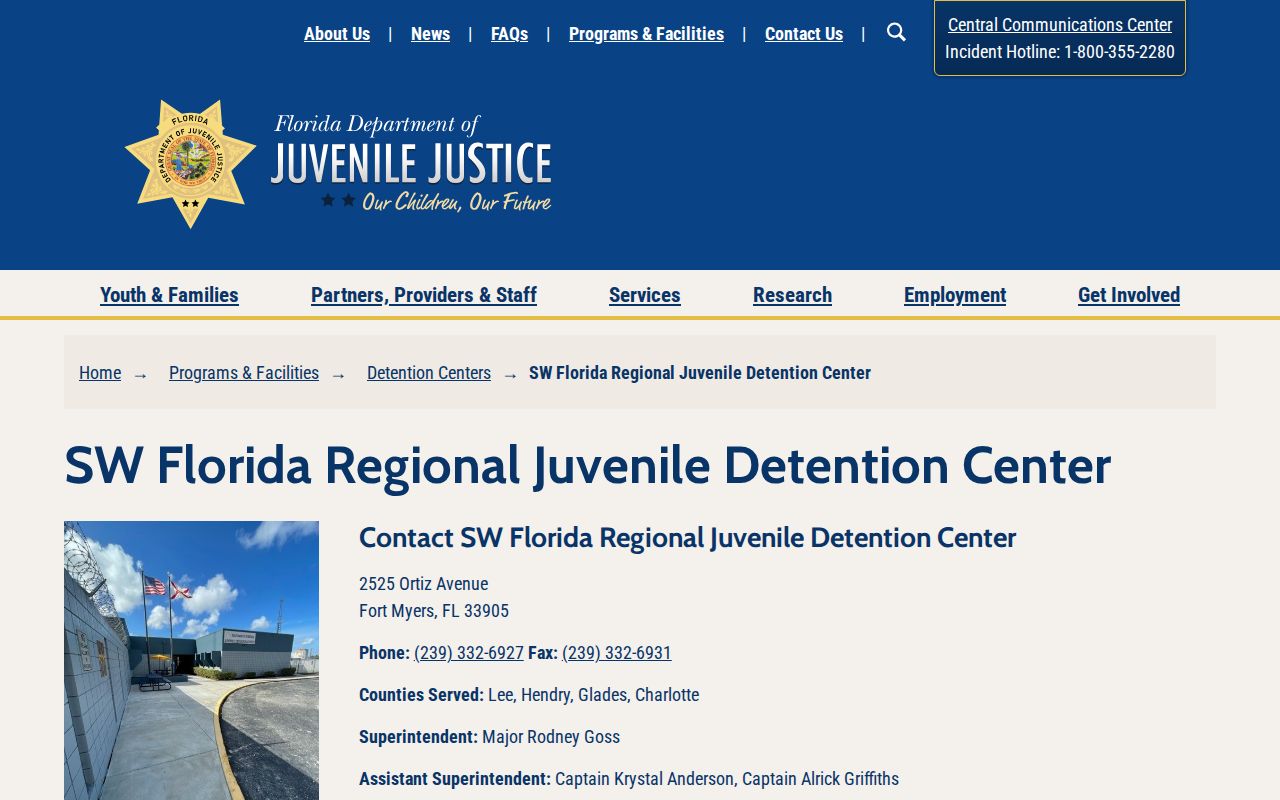
The image confirms the regional center's DJJ identity, which is why adult county and state offender portals are the wrong route.
Glades Youth Release Aftercare
The Glades County Probation and Community Intervention Program serves Circuit 20 youth. DJJ lists detention screening, intake, diversion, probation, aftercare supervision, and provider links. It is a juvenile program, not FDC adult felony supervision or the local adult misdemeanor office.
Aftercare is structured support or supervision after a youth leaves a placement. Probation is court-ordered community supervision. Neither term means the case is fully discharged. The court order and authorized DJJ record explain the current status and any remaining conditions.
The Glades program source provides the local connection.
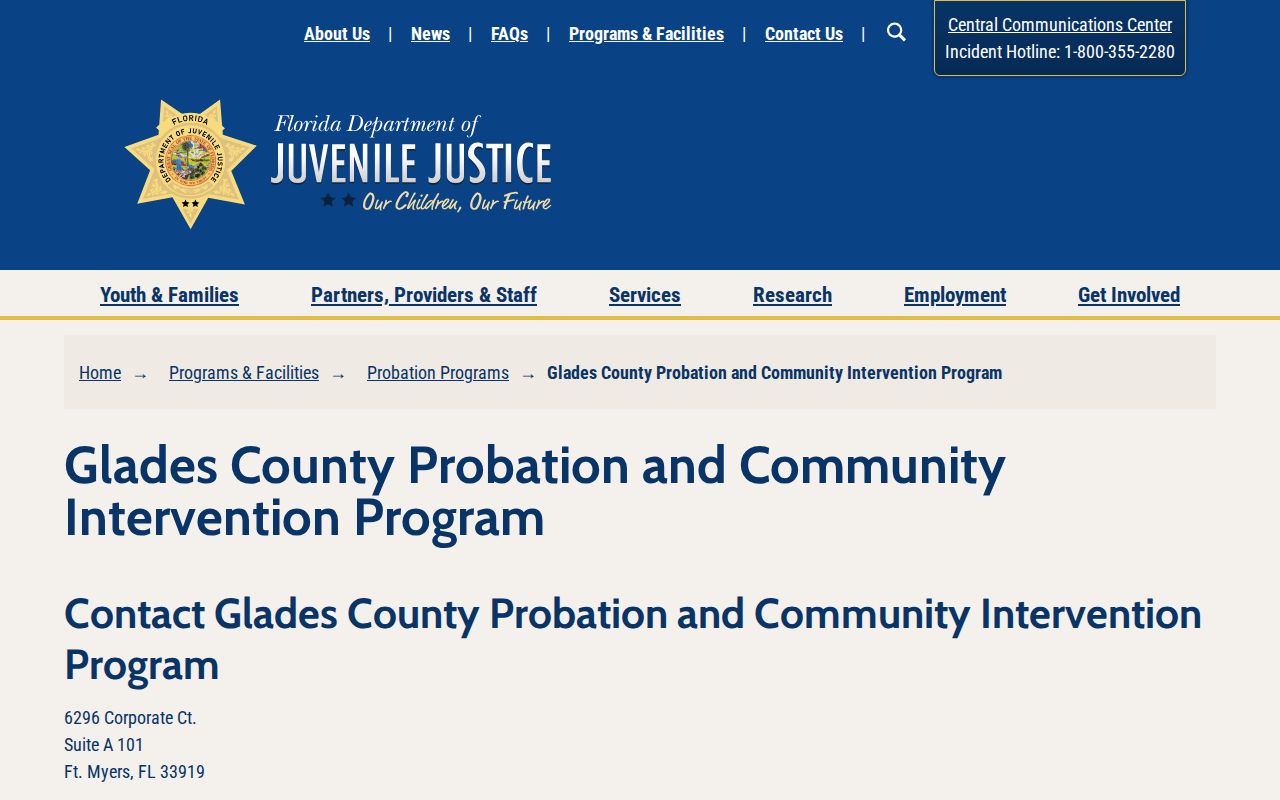
The program page distinguishes local youth follow-up from the secure detention center and from adult corrections.
Regional Youth Release Context
DJJ reports 50 hardware-secure beds and an approximate average secure-detention stay of 11 days. Those are program-level facts, not a prediction for one youth. A case may move at a different pace because of court scheduling, placement needs, legal status, or other case-specific factors.
The center holds youth awaiting the next juvenile justice step. It is not a prison serving a fixed adult sentence. No public released-inmate feed, release clock, or adult-style historical locator is documented for this facility.
Youth Release Record Limits
Confidentiality can restrict names, photos, case facts, medical information, and placement details. Some serious cases or adult-transfer proceedings may have different public-access rules, but they do not make the adult jail portal a universal juvenile search. Requesters should ask the juvenile court clerk or DJJ which nonconfidential record can lawfully be provided.
A court order can explain the legal disposition, while DJJ can address the custody or program movement within the limits of the requester’s authority. Those records answer different questions. Neither should be inferred from social posts, an adult no-result, or a general web search.
Note: Juvenile privacy rules protect the youth even when a regional facility clearly serves Glades County.
Glades Youth Court Dispositions
The juvenile case supplies the legal basis for detention and the next ordered step, but access differs from an adult criminal docket. An authorized requester may ask for an adjudication, disposition, placement, probation, or termination order that the law permits them to receive. Court and DJJ staff may require proof of identity, relationship, or legal authority before confirming protected information.
A detention departure and a case outcome are separate facts. Return to a guardian does not mean the petition was dismissed. Placement does not mean release to the community. Probation and aftercare take place outside secure detention while DJJ or court authority continues. The court order and authorized DJJ record should agree before the outcome is described.
Florida's juvenile confidentiality rule has exceptions for some serious cases and adult transfers. Those exceptions do not turn SmartWEB or FDC into a general youth locator. The custodian decides which portions may be disclosed and which must be redacted. A public no-result cannot settle whether a youth was released, transferred, or placed.
Request Youth Release Records
A useful request identifies the youth, Glades County case number when known, approximate detention dates, the precise existing record sought, and the requester's relationship or authority. Ask for a movement record, disposition order, placement order, or probation status only when the item is relevant and lawfully available. Do not ask staff to create a narrative or infer a destination that no record states.
When the regional center cannot release information, ask which DJJ program or juvenile court division holds the record and what proof is required. Counsel can address a disputed access issue. The lack of an adult-style public search is not a database flaw. It reflects the confidentiality rules that govern youth records.
- Secure detention
- Locked custody while a youth awaits a juvenile court step.
- Placement
- A court-directed program or setting following disposition.
- Aftercare
- Support or supervision following a residential or detention phase.
- Discharge
- Formal completion of the applicable juvenile justice obligation.
VINE should not be promised as a permanent youth release archive. Confirm whether the agency and record appear in the live Florida service and whether the requester may receive the event. Even a custody alert does not replace a DJJ movement record or court disposition.
Southwest Florida Release Verification
Verification should follow the actual outcome. For return to a guardian, an authorized DJJ contact or court record can confirm the event. For placement, use the court order and responsible program. For probation or aftercare, contact the Glades County Probation and Community Intervention Program. Each route respects the difference between leaving a locked center and ending juvenile justice involvement.
The regional center's reported average stay cannot predict one youth's date. Court calendars, placement availability, case posture, and legal orders can change the timeline. Do not calculate a release date from the approximate average or assume that a short stay ended in community release.
Adult jail photos, state offender details, and general web results may concern a different person or later adult event. Match a youth only through the authorized case and agency records. That approach protects privacy and prevents an adult custody record from being attached to a juvenile release.
Glades Youth Release Record Roles
DJJ and the juvenile court answer different parts of the inquiry. DJJ can address the authorized custody or program movement. The court order states the legal disposition and any probation or placement terms. Neither source should be stretched beyond its role, and an adult portal cannot fill a protected gap.
When release is followed by aftercare, confirm both the detention exit and current program status. Formal discharge occurs only when the applicable juvenile justice obligation ends. This distinction keeps a community placement or supervised return from being mislabeled as completion of the whole case.