
Glades County Court Release Records
The Glades County Courthouse and Twentieth Judicial Circuit case system is a court-record source, not a detention facility. It does not hold or release a person. Its role in a release search is to explain the judicial event behind custody. A bond order may permit a person to leave jail while the prosecution continues. A judgment and sentence can show a custodial term and jail credit. A later order can terminate probation or record another case outcome.
The physical exit belongs to the custody record. GCSO SmartWEB can show Status: Released and an exact Released: timestamp for a county booking. FDC records show state-prison custody and discharge. The court file supplies filed charges, pleas, adjudication, disposition, sentence, bond rulings, warrants, and later orders. Using those records together avoids treating release from one jail as proof that the case ended.
| Question | Best Glades County source |
|---|---|
| When did GCSO custody end? | SmartWEB release timestamp or the sheriff release record |
| What court event allowed release? | Bond, release, disposition, or sentencing entry in the court case |
| Did the prosecution end? | Filed disposition, dismissal, nolle prosequi, acquittal, or judgment |
| Was supervision completed? | Termination or discharge order, when filed |
| Did custody continue elsewhere? | Receiving jail, FDC, BOP, or ICE record |
Note: The court case explains legal action, while the holding agency's movement record establishes the actual custody change.
Search Glades County Court Records
The Clerk links the official Glades County Online Court Records Search, county 22. It offers anonymous public access and separate credentialed access types under Florida court-access rules. A case number is the most precise route because names can vary and may match more than one person. SmartWEB charge rows can supply that number for a Glades County booking.
- Open the GCSO release record and copy the court case number, booking number, release time, and arresting agency.
- Open the county 22 court portal and search the exact case number. Use a party search only when the number is unavailable.
- Confirm the party and case type. Do not merge separate felony, misdemeanor, or criminal-traffic matters.
- Review the docket for bond action, release orders, plea, disposition, judgment, sentence, jail credit, warrants, and later termination entries.
- Compare the legal event with the GCSO timestamp or the receiving custody record.
- Request the needed filed document from the proper Clerk criminal division when the portal does not provide an image.
The successful manifest capture of the official county 22 portal shows the Glades County case-search entry.
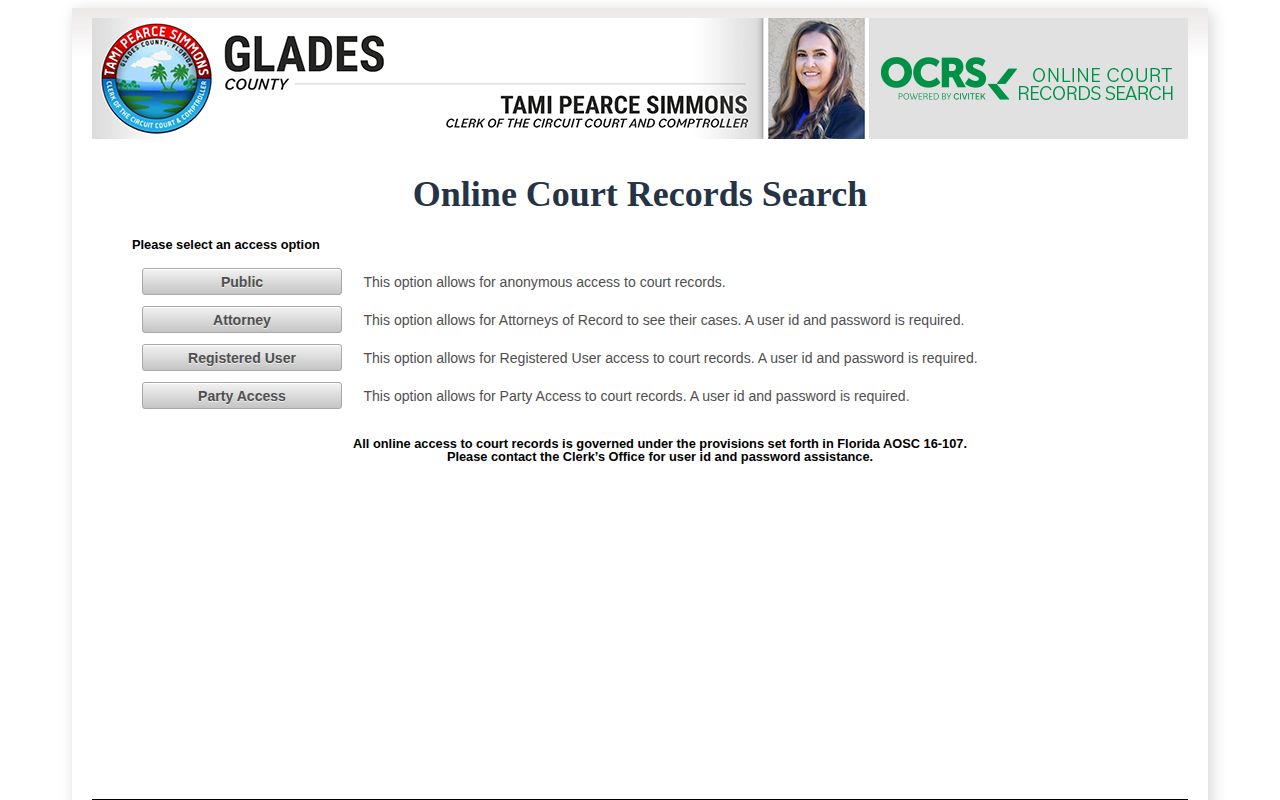
The portal is the bridge from a booking case number to the enduring court file, not a replacement for the jail or prison locator.
Read Glades County Release Orders
A docket is a chronological list of case activity. It can point to the document that matters, but the docket label alone may not contain the full terms. Inspect the filed order when available. A bond entry can show the amount or conditions that allowed pretrial release. A plea and judgment can show the formal outcome. A sentence can state jail or prison time and credit, while a termination order can establish that a later supervision term ended.
| Court field or document | What it can establish |
|---|---|
| Case number and party | Connects the SmartWEB charge to the correct court matter. |
| Bond or release order | Shows judicial authority and conditions for leaving pretrial custody. |
| Plea and disposition | Records how a charge was resolved or whether it remains pending. |
| Judgment and sentence | Shows the imposed term, custody type, and court-ordered credit. |
| Warrant or capias | Shows later court process that may lead to a new arrest. |
| Termination or discharge order | Can document completion of probation, community control, or another court term. |
An original sentence is not proof of the actual exit date. Credit can affect a calculation, and another agency may take custody. The Glades County release-record search path sets out how the court, jail, FDC, federal, and immigration records fit together.
Glades County Criminal Record Divisions
Case level determines the local office. The Clerk's felony division says Circuit Criminal maintains felony files. The criminal traffic and misdemeanor division identifies County Court as the route for those matters. A single booking can contain charges at different levels, so the booking page should not be used to guess which court division owns every record.
The manifest capture of the Glades misdemeanor and criminal-traffic page documents that local routing.
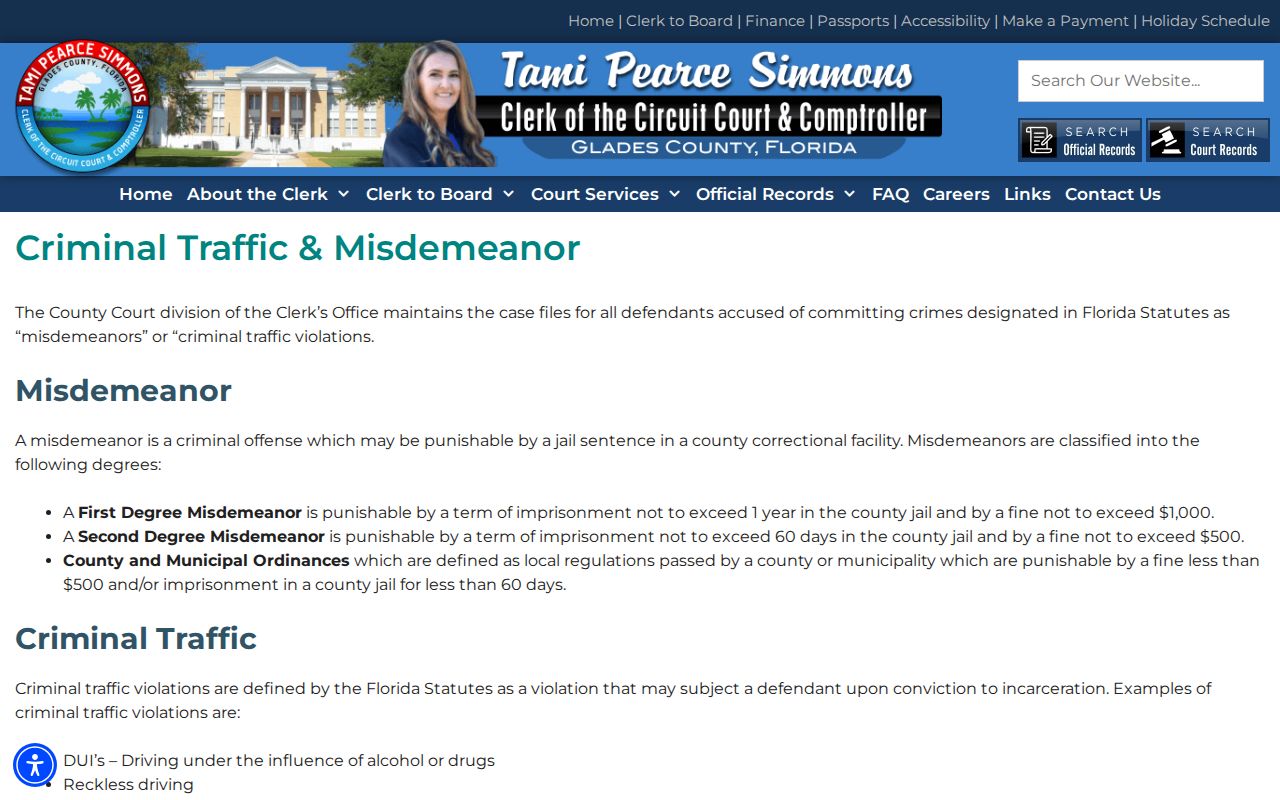
Use the case type and number to address a copy request to the correct division rather than sending a broad inquiry to the jail.
- Circuit Criminal
- The Clerk division that maintains felony case files.
- County Court
- The local division for misdemeanor and criminal-traffic matters described by the Clerk.
- Disposition
- The formal recorded outcome of a charge or case.
- Nolle prosequi
- A prosecutor's filed decision not to continue a charge at that time.
- Certified copy
- A copy authenticated by the Clerk for uses that require certification.
Request Glades County Court Records
When an online docket lacks the needed image, request a paper or certified copy from the appropriate criminal division. Make the request specific under Florida Rule of General Practice and Judicial Administration 2.420(f)(1). Identify the case number, party, document title, and approximate filing date. Useful release-related records can include a bond or release order, certified disposition, judgment and sentence, jail-credit provision, and supervision-termination order.
Glades County Clerk criminal divisions500 Avenue J, Suite 500
Moore Haven, FL 33471
Phone: 863-946-6010
Published office hours were not stated in the research.
Mail-copy estimate: 7 to 10 working days
Published charges are $1 per page, $2 for a name or case search, and $2 more for certification. Before mailing, call for the page count and total cost. Include a self-addressed stamped envelope and do not mail cash. Those Clerk fees and timing apply to court copies. They are separate from the GCSO records charges and mail workflow.
Florida public-record law generally requires good-faith handling and production of nonexempt parts, but court access is also governed by court rules. Some victim, juvenile, medical, sealed, expunged, or otherwise confidential material may not be publicly viewable. A missing image should lead to the Clerk, not to an assumption that the case never existed.
Note: Ask for named filed documents and certification only when needed; the court record does not supply the jail's physical release timestamp.
Offsite Glades County Case Records
Glades County has a practical archive detail that changes the search. The Clerk says inactive criminal files may be stored offsite and can take a day or so to retrieve. A blank document screen or missing image is therefore not the end of the record search. Call the criminal division before travel or a mailed request and ask whether the file must be brought back from storage.
This finding forms the court-record counterpart to SmartWEB. The jail record supplies the case number but not a dependable stand-alone release reason. The county 22 portal carries that number into the surviving criminal case. If the portal has only a docket entry, request the filed order. If the file is inactive, allow for offsite retrieval before concluding that the disposition or sentence is unavailable.
The Clerk's E-Notify service has a different purpose. It sends reminders for court events in felony, misdemeanor, and criminal-traffic cases. VINE sends custody-change alerts from participating agencies. A court reminder is not a release alert, and a VINE event is not a court disposition.
Glades County Sealing Records
Sealing and expunction follow a formal Florida process. It begins with FDLE's Certificate of Eligibility application and supporting material, then proceeds to the court. Certified dispositions are required for each charge, and proof that probation ended may be needed. Diversion can require a completion certificate or letter. The certificate is not itself a court order and does not guarantee that relief will be granted.
After a judge signs an order, public access changes according to the governing statute. A sealed record remains available to entities authorized by law. An expunged record is more tightly restricted. FDLE recommends obtaining needed arrest reports, certified dispositions, and orders before expunction because even the subject may later need a court order to obtain the expunged record.
Retention is not the same as online display. Florida court rules set long retention periods for many criminal matters, while some dismissed or unfiled matters have different schedules. A retained docket does not mean every image is remotely accessible. Use the currently effective rule, the Clerk's archive process, and any sealing or expunction order to explain why a Glades County record is or is not public.