
Moore Haven Release Outcomes
Moore Haven is a state-contract prison for sentenced adult men. It is not the Glades County jail. Leaving the institution may mean movement to another Florida Department of Corrections location, release to community supervision, or full discharge. A transfer ends residence at Moore Haven but does not end FDC custody. The state detail's current location and status make that distinction.
Release to parole, conditional release, probation, or another supervision type also differs from discharge. Physical departure from the secure facility can occur while FDC Community Corrections continues field supervision. The Florida Commission on Offender Review has authority over parole and certain Commission-controlled release types. Read the exact state label instead of treating every prison departure as parole.
| State record | What it establishes |
|---|---|
| Current location | Whether the person remains at Moore Haven or another FDC institution |
| Released status and past date | Evidence that the recorded FDC custody event ended |
| Supervised Population detail | Whether community control continues after prison |
| Sentence history | Case, county, offense, term, and related dates |
Confirm Moore Haven Release
Start with FDC Inmate Release Information. Search by the six-character DC number when possible. A name search supports last and first names, but aliases and prefix matching can widen results. Compare the photograph, birth date, physical description, offense, county, and case before relying on a record.
- Search the DC number or full legal name in FDC.
- Open the matching detail and read current status and location.
- Compare release, out-custody, incarceration-history, and sentence dates.
- Check the Supervised Population search if the person may be under community control.
- Request the official movement or discharge record when the public history is missing or unclear.
A future date on an active record is prospective and may change. A past release date paired with released status and an out-custody entry is stronger evidence of a completed FDC event. County SmartWEB is relevant only to a separate GCSO booking episode. It cannot confirm release from this state prison.
The FDC search landing form shows the available state lookup categories.
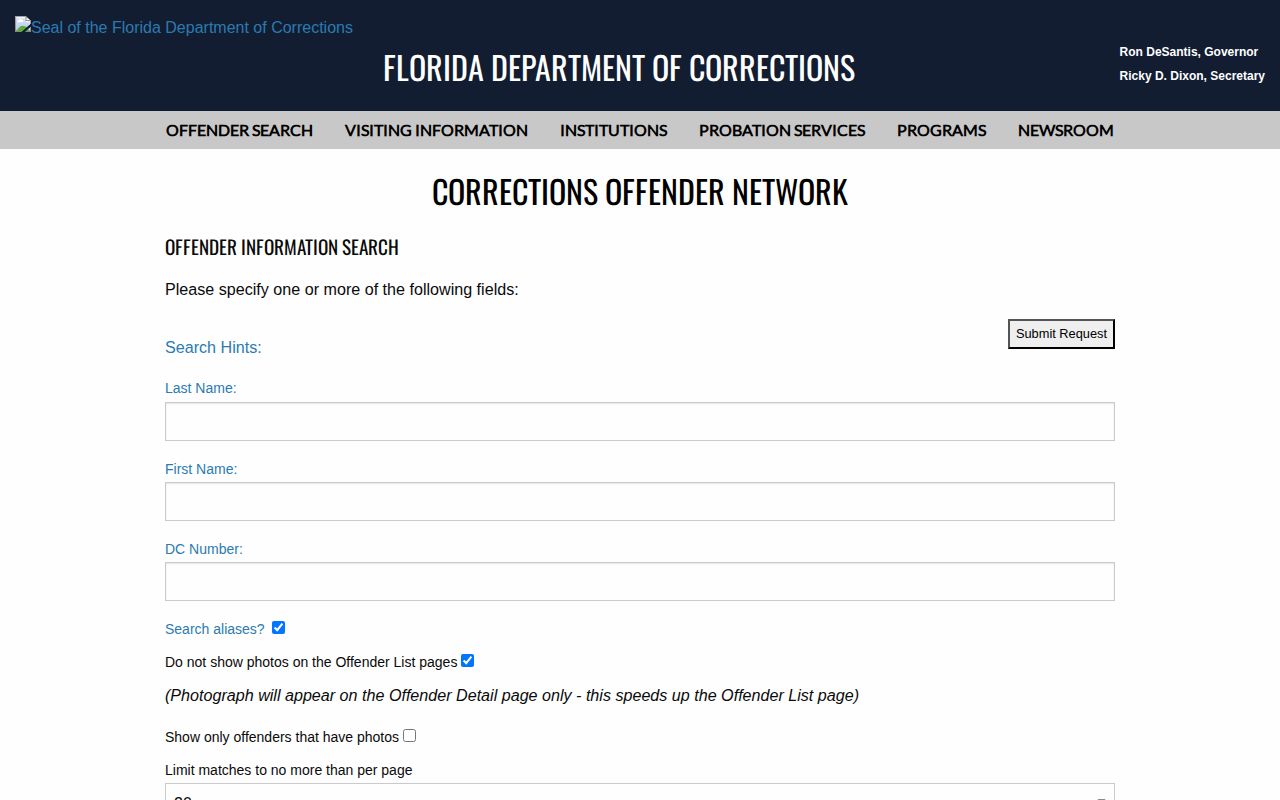
The state form directs readers to inmate, release, and supervision records without mixing them with the county jail roster.
Moore Haven Release Records
For an official state record, use FDC Public Records. Identify the person by name, DC number, birth date if known, institution, and date range. Ask for the existing release or discharge record, movement history, sentence data, or image needed. FDC records explain state custody. They do not explain why someone left the Glades County jail before any state commitment.
1282 East State Road 78
Moore Haven, FL 33471
Phone: 863-946-2420
Release-information questions may also be directed to the FDC Bureau of Admission and Release at 850-488-9167 or dc.release@fdc.myflorida.com. The public Inmate Release Information database updates nightly. Ask for a cost estimate on a records request because volume, format, review, and redaction can affect fees.
Note: A records request should seek an existing movement or discharge record, not ask the custodian to create a new explanation.
Moore Haven State Custody
GEO describes Moore Haven as a 985-bed, medium-custody secure adult-male state-contract institution. Florida's Department of Management Services is the client, while FDC systems provide the state offender-record context. This operator and client structure does not change the public search route. A sentenced person held there should be traced through FDC.
The facility's published page appears in the GEO directory.
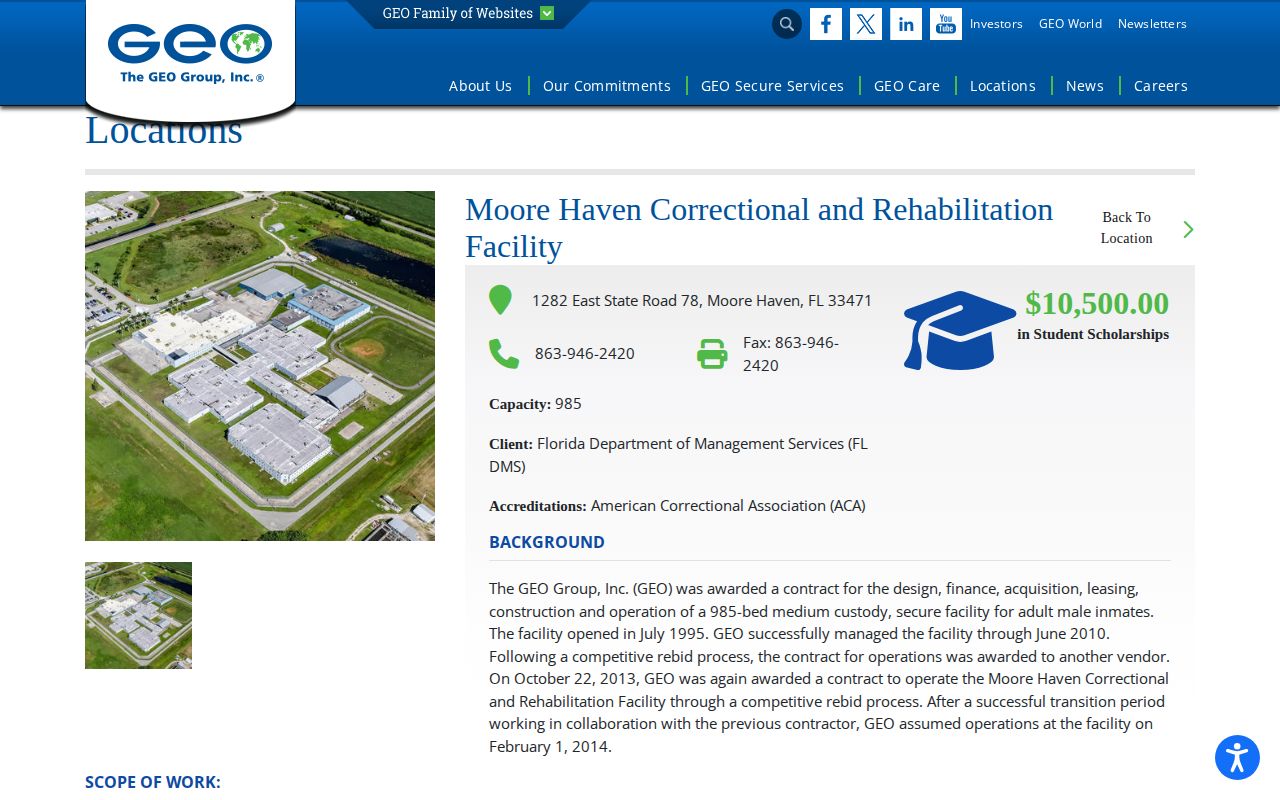
The source identifies the institution and operator, while FDC remains the correct source for individual state custody and release status.
Moore Haven Release Planning
GEO reported a reentry seminar held at Moore Haven on July 12, 2024 with several community organizations. That supports a limited conclusion: the facility has hosted programming that connects people with release planning and community services. It does not establish that each person receives the same plan or that a public release destination is available.
FDC status should still control verification. Community plans can change, and some people leave for another institution rather than the community. A court case, detainer, or supervision term may also affect what happens next. For a current post-prison status, compare the released record with FDC Community Corrections.
Moore Haven Facility History
The institution opened in July 1995. GEO says it operated the facility through June 2010, another provider followed a rebid, and GEO resumed operations on February 1, 2014 after an award dated October 22, 2013. This history helps distinguish the state facility from the county detention center nearby on the same road.
That geographic closeness can lead to the wrong search. GCSO SmartWEB covers the county jail episode. FDC covers Moore Haven prison custody and state supervision. The two records may both exist for one person at different points, but neither substitutes for the other.
Moore Haven Release Date Fields
FDC release records form a timeline. An active detail may display a Current Release Date, but Florida law calls the underlying calculation a tentative release date. Eligible gain-time can advance it, forfeited credit can delay it, and another sentence can require recalculation. The date cannot be later than maximum sentence expiration. A mandatory minimum, ineligible offense, life sentence, detainer, or other legal limit may control instead.
For qualifying modern offenses, section 944.275 limits gain-time so release cannot occur before at least 85 percent of the imposed sentence has been served, including qualifying jail credit. That is a floor, not a promise of release at 85 percent. For a completed Moore Haven release, look for a past Release Date, released status, and incarceration-history out-custody date that agree. Request the movement history when they conflict.
Sentence history adds the county, case number, offense, term, and sentence dates. Detainer entries may identify another agency's interest after FDC custody. Some records may include a stated residence, but it is not promised. The court docket controls the full legal description because FDC warns that offense wording can be shortened.
Moore Haven Supervision Records
The FDC Supervised Population Search is the next channel when prison release may continue into community control. A detail can show Supervision Begin Date, Current Location city, Current Status, Supervision Type, Scheduled Termination Date, verified address, aliases, and case history. FDC says the full database refreshes weekly while termination dates and location changes update nightly. Two views may therefore differ briefly.
Use the DC number to link prison and supervision records. Do not infer the field office from Glades County or the sentencing county. A released person may report to the circuit serving the place where they live. FDC Probation and Parole Field Services routes public status questions at 850-717-3444 and co-supervision@fdc.myflorida.com.
When the status is parole, conditional release, conditional medical release, or another Commission matter, an FCOR agenda proves only that the case was scheduled. The final order establishes the action. Full discharge is the end of the applicable custody and supervision obligations. Departure from Moore Haven alone does not establish that endpoint.
Note: A transfer, prison release, and supervision discharge are three different state record events.
Moore Haven Records Fallback
A public no-result should lead to an FDC records request, not to county SmartWEB. Identify the person by full name, DC number, birth date if known, Moore Haven institution name, and the date range. Ask for the existing release or discharge record, movement history, sentence record, and supervision termination record that answer the question.
For a legal basis, compare the FDC movement with the sentencing court case. FDC proves state custody and movement. The court proves the judgment or later order. This two-record check is especially useful when a person left Moore Haven for another prison or when a detainer led to a new custody episode.