
Detention Center Release Destinations
A Glades County Detention Center release ends the person's custody under the Glades County Sheriff's Office. It does not always end all custody. A court-authorized bond can send the person back to the community while the criminal case remains open. Completion of a county sentence may also result in community release. A transfer, by contrast, may place the person with the Florida Department of Corrections, another county jail, the Federal Bureau of Prisons, the U.S. Marshals Service, or Immigration and Customs Enforcement.
The official SmartWEB result supplies a precise Released: timestamp, released status, booking and MNI numbers, booking image, charge data, bond information, and the court case number. It does not provide a dependable standalone field naming the reason or destination. Treat the timestamp as proof that the GCSO episode ended. Then use the case number in the court docket and select the likely receiving locator. The full Glades County released-inmate search path explains how those systems fit together.
Confirm Detention Center Releases
The GCSO SmartWEB Jail View is the direct public route for this facility. Its default booking view is not the released-person view. Switch the search type to Released Inmates Only. Search by surname and add a release-date range when one is known. A broad first search is safer when spelling or timing is uncertain.
- Choose Released Inmates Only and enter the name or likely date range.
- Match the image, demographics, booking number, MNI number, and case number rather than relying on the name alone.
- Record the displayed release date and time. Expand the charges for the arresting agency and court case number.
- Search the Glades Clerk docket to learn whether bond, sentence completion, dismissal, or another order explains the move.
- If transfer is possible, check FDC, ODLS, BOP, or the receiving county system.
A person who remains in the current-only SmartWEB results is still listed in GCSO custody. Someone in released-only results has left GCSO custody. A no-result proves neither fact because date range, spelling, data delay, juvenile confidentiality, sealing, or archive practices may affect the public screen.
Detention Center Release Records
The GCSO Records Department accepts requests in person, by mail, and by email. Ask for an existing booking sheet and release record. Include the full name, birth date if known, booking or MNI number, and an approximate booking and release range. Specify the actual release date and time, recorded disposition or destination, and booking photograph if each is needed. A focused request is easier to locate than a broad demand.
1297 East State Road 78
Moore Haven, FL 33471
Mail: P.O. Box 39, Moore Haven, FL 33471
Phone: 863-946-1600
Email: Public_Records@gladessheriff.org
Records-office hours are not published.
GCSO posts charges of $1 per copy, $1.50 for a two-sided copy, $7 per CD or DVD, and $2 for a local records check. Ask for an itemized estimate before special-service work. The office says mailed research is returned within five business days after receipt when the request includes a sufficient stamped return envelope, subject to its investigation caveat. Florida public-record law may also require redaction of protected parts while permitting release of nonexempt material.
The official records page shows the request channels and fees.
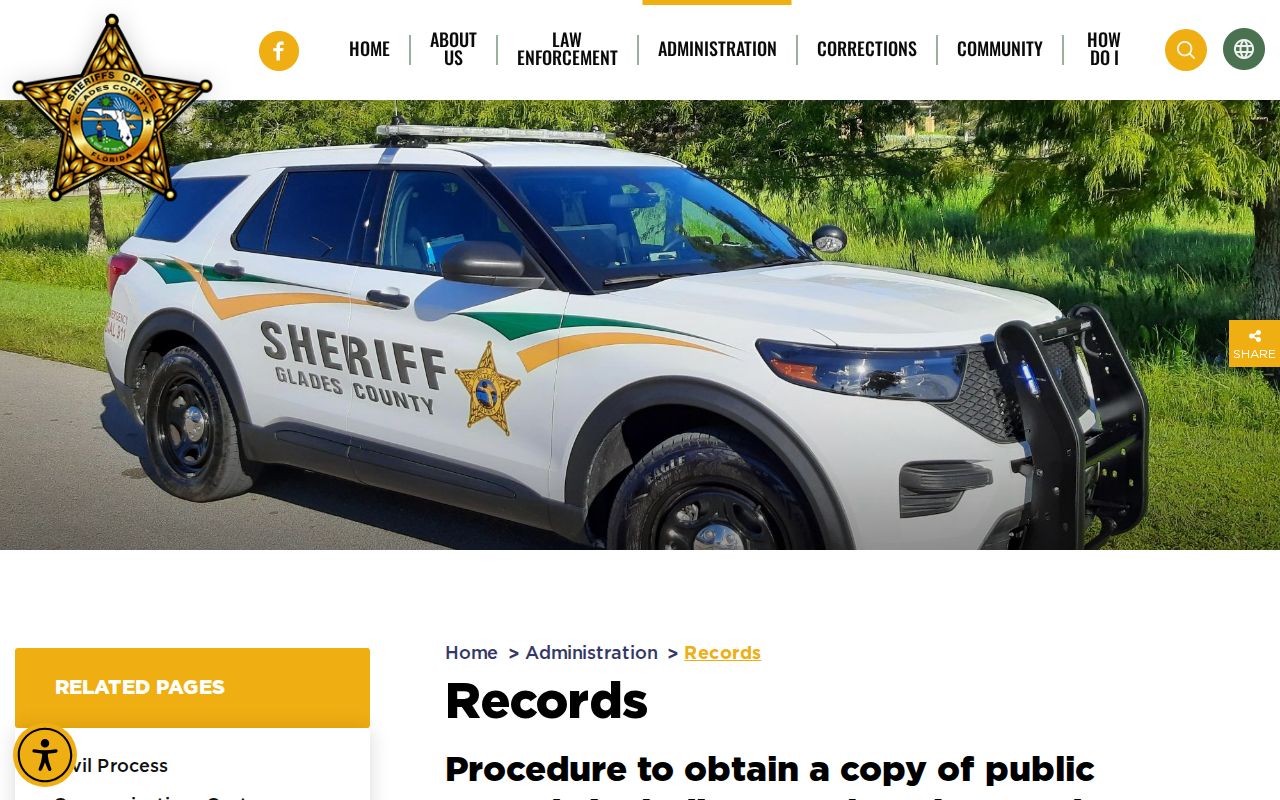
The captured page is the best source for checking current GCSO request instructions before sending a release-record request.
Detention Center Booking Process
GCSO inventories money, clothing, and miscellaneous property during intake and performs medical screening. It assesses a $25 booking fee to nonfederal inmates. If the case is dismissed or the person is found not guilty, GCSO says the person may provide the court documents so the booking fee can be returned. The court case number shown in SmartWEB helps locate that disposition.
A person who does not bond out receives a first appearance before a judge within 24 hours, either in person or by video. A bond-out can thus create a released status while prosecution continues. The jail does not publish its discharge desk, exit point, daily release schedule, family waiting area, weekend practice, or property-return procedure. Call the facility instead of inferring those details. The jail phone is 863-946-1600, and the published fax is 863-946-0845.
- Bond release
- Departure from jail under court-set financial or other conditions while the case continues.
- Time served
- Completion of the custodial time ordered in the case.
- Transfer
- Movement out of GCSO custody into another agency's custody.
- Detainer
- A request by another agency to hold or notify it about a person who might otherwise leave.
ICE Holds After Glades Release
The immigration branch is a core Glades County issue. The same complex houses ICE detainees, and GCSO maintains an official ICE-DHS information page. An immigration detainer can ask the jail to notify ICE before ordinary release and keep a person for up to 48 hours beyond the point when they would otherwise leave, so DHS can assume custody. A SmartWEB release can therefore be a county-to-ICE handoff.
When that path is plausible, use the ICE Online Detainee Locator with an A-number and country of birth or exact biographical details. ODLS may retain a not-in-custody result for about 60 days after ICE release. Later absence is inconclusive. A locator record also may not state the legal reason or final destination. Contact the ICE Detention Reporting and Information Line at 1-888-351-4024 on weekdays from 8 a.m. to 8 p.m. Eastern when the locator does not resolve the movement.
Note: A GCSO release and an ICE release are separate events, even when both custody episodes involve the same Moore Haven complex.
Glades Detention Center History
The county jail and the nearby state-contract prison sit on East State Road 78, but they use different record systems. GCSO says the Glades Correctional Development Corporation developed, financed, and constructed the sheriff and jail complex and sponsored a $33 million bond. The sheriff manages the completed facility, while the corporation manages funding and debt repayment. An ICE inspection states that the center opened and began holding ICE detainees in June 2007.
This history explains why the building can appear in both local and immigration records. It does not turn a county booking into an FDC prison record. SmartWEB tracks the local GCSO episode. FDC tracks state prison custody. ODLS tracks ICE detention. Keeping those systems apart prevents a false claim that someone is free merely because one roster no longer lists them.
Glades County Release Case Check
SmartWEB's court case number is the bridge from the jail event to the legal case. Search the Glades County Online Court Records portal by that number when possible. Review the docket for a bond order, release order, plea, disposition, judgment and sentence, jail credit, probation terms, warrant, or later termination order. A bond order can explain why the person left jail while charges remained pending. A dismissal or not-guilty disposition explains the case outcome but does not replace the jail's actual release timestamp.
The criminal division depends on the charge level. Circuit Criminal maintains felony cases, while County Court handles misdemeanor and criminal-traffic matters. GCSO can list more than one charge, so verify which court file contains the event. The Clerk says inactive files may be stored offsite and take a day or so to retrieve. A missing online document is therefore not proof that no order exists.
For a paper or certified record, contact the Glades Clerk criminal divisions at 500 Avenue J, Suite 500, Moore Haven, or 863-946-6010. Published charges are $1 per page, $2 for a name or case search, and $2 more per certification. The Clerk estimates 7 to 10 working days for mailed copies after the cost and page count are resolved.
Note: The jail timestamp proves the physical exit, while the court file explains the legal event that authorized or followed it.