
Glades County ICE Release Paths
ICE Enforcement and Removal Operations uses the Glades County Detention Center for federal immigration detention. GCSO operates the county facility, but ICE controls immigration custody and its release or transfer decisions. That shared location creates two distinct records. SmartWEB can document the end of a GCSO jail episode. ICE's Online Detainee Locator System, known as ODLS, is the proper public path for current immigration detention and certain recent release results.
Leaving the county-facing record does not establish release from ICE. A person may move from a local criminal matter into immigration custody, transfer to another ICE facility, be removed, or be released under immigration authority. The county timestamp proves only departure from the county custody episode. Conversely, an ODLS result does not explain a local bond, criminal disposition, or state-prison movement.
| Event | What it proves | Next source |
|---|---|---|
| GCSO Status: Released | The person left the Glades County jail episode shown. | ODLS when an immigration handoff is possible |
| ODLS in custody | ICE reports current detention within the locator's scope. | ICE facility or ERO contact for unresolved location details |
| ODLS not in custody | ICE reports no current detention for the matching recent record. | Immigration case or ICE record for legal basis and destination |
| No ODLS result | Nothing conclusive by itself because scope, spelling, exclusions, age, time, or lag may matter. | ICE information line and the appropriate case record |
Note: A Glades County jail release can be an ICE handoff, so county departure and immigration release must be verified separately.
Search Glades County ICE Custody
Open the official ICE Online Detainee Locator System. The strongest search uses an exact A-number and country of birth. The A-number must have nine digits, so add leading zeroes when the known number is shorter. The other route uses the exact biographical name, country of birth, and an optional birth date. Spelling, spacing, and hyphenation can affect a result.
- Choose the A-number route when that identifier is known. Enter all nine digits and the correct country of birth.
- Otherwise, enter the exact first and last names, country of birth, and birth date when available.
- Compare the returned identity details before treating the record as a match.
- Read the exact in-custody or not-in-custody wording. Do not add a release reason the locator does not provide.
- When the result is missing or unclear, contact ICE with the same identifiers and the last known Glades County location.
- Keep the GCSO release timestamp and immigration case information separate from the ODLS status.
ICE says ODLS covers current detainees and people released from ICE custody during the previous 60 days, subject to exclusions and data-feed lag. Records for people under 18 do not appear. A result beyond that recent window can disappear, so later absence cannot prove whether or when a prior ICE release occurred.
Read Glades ICE Custody Results
An ODLS status is narrower than a full immigration case history. “In custody” indicates current ICE detention for the matching locator record. “Not in custody” means the person is not currently detained by ICE within the record's scope. It does not state whether the person returned to the community, departed the United States, moved under another authority, or remains subject to immigration proceedings.
Use a custody chain to avoid gaps: GCSO booking and release, possible ICE handoff, ODLS status, then the immigration case or agency record. If the person first appeared in SmartWEB, record the booking number, MNI number, release time, and court case number. Those identifiers belong to the local episode. The A-number is the key immigration identifier and should not be replaced with the county booking number.
- A-number
- The immigration identifier used with country of birth in the strongest ODLS search route.
- Detainer
- An ICE request for notice before release and continued custody for a limited handoff period.
- Transfer
- A move between custody locations or agencies, not release to the community.
- Removal
- An immigration action distinct from release into the community.
- Feed lag
- A delay between an agency event and its appearance in the public locator.
The Glades County released-inmate search path explains how the local timestamp, court case, FDC record, BOP locator, and ICE result answer different parts of a custody question.
Glades ICE Records and Contact
Use ODLS first. When it does not resolve the movement, contact the ICE Detention Reporting and Information Line with the full name, A-number, country of birth, birth date, and last known facility. The research places the Glades facility within ICE's Miami field-office structure. Ask for help identifying current detention or the correct office rather than asking GCSO to interpret a federal immigration result.
ICE detention inquiryGlades County Detention Center
1297 East State Road 78
Moore Haven, FL 33471
ICE DRIL: 1-888-351-4024
Monday through Friday, 8 a.m. to 8 p.m. Eastern
Search ODLS first
The official ICE Glades County Detention Center page is the agency facility source.
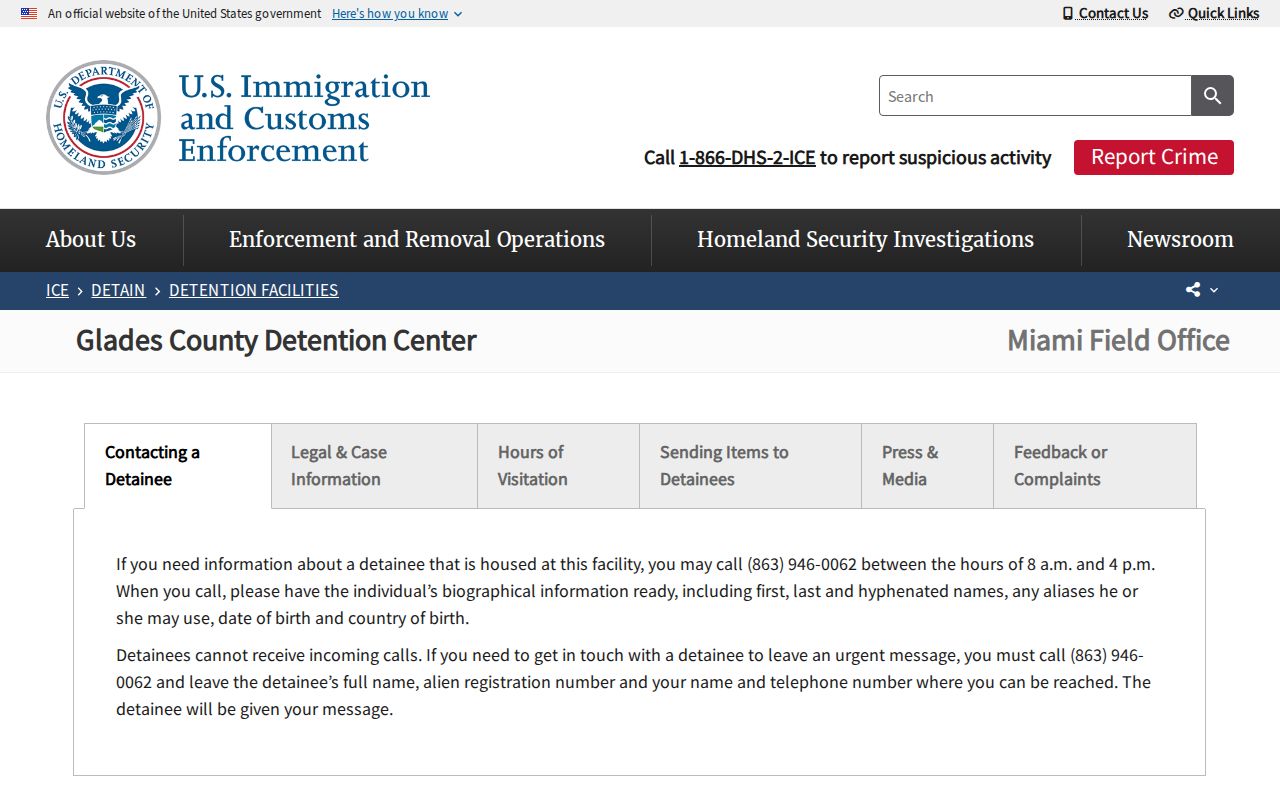
The facility page supports the ICE route; it should not be replaced with the county jail's local release search.
If a historical release or transfer needs documentary proof, request the appropriate existing ICE record and check the immigration case or order. ODLS is a locator, not a certified movement history. GCSO Records can answer the county episode but cannot supply the legal basis for an ICE decision.
Glades County ICE Handoffs
An immigration detainer asks another law-enforcement agency to notify ICE before ordinary release and to keep custody for up to 48 hours beyond the point when the person would otherwise be released so DHS can assume custody. That rule makes a SmartWEB release timestamp especially easy to misread in Glades County. It can mark the end of GCSO custody while federal detention begins.
The ICE detainer explanation supplies the federal handoff rule. The county record may still lack a stand-alone destination field. When an immigration detainer is plausible, run ODLS and contact ICE if the locator does not resolve the move. Do not describe the county status as a return home without that next check.
ICE announced on April 2, 2025 that it reinstated an agreement with the Glades County Board of County Commissioners that created capacity for up to 500 immigration beds at the jail. That documented local role makes the handoff issue concrete rather than hypothetical. The agreement's capacity is not a count of current detainees or releases.
Note: ODLS may retain a recent not-in-custody result for about 60 days, but later absence is not historical proof.
Glades ICE Detention History
The jail complex has a distinct development history. GCSO says Glades Correctional Development Corporation was commissioned to develop, finance, and construct the sheriff and jail complex and sponsored a $33 million bond. The sheriff manages the completed facility, while the corporation manages funding and debt repayment. This arrangement helps explain why the county site and federal ICE materials can describe different functions at the same Moore Haven address.
An official ICE inspection says the detention center opened and began holding ICE detainees in June 2007. It reported ownership by Glades Correctional Development Corporation and operation by GCSO, with historical detention of men and women across classifications for more than 72 hours. Those facts describe the facility and inspection period. They do not establish any named person's status.
The GCSO ICE-DHS page confirms the local federal role and links the official locator.
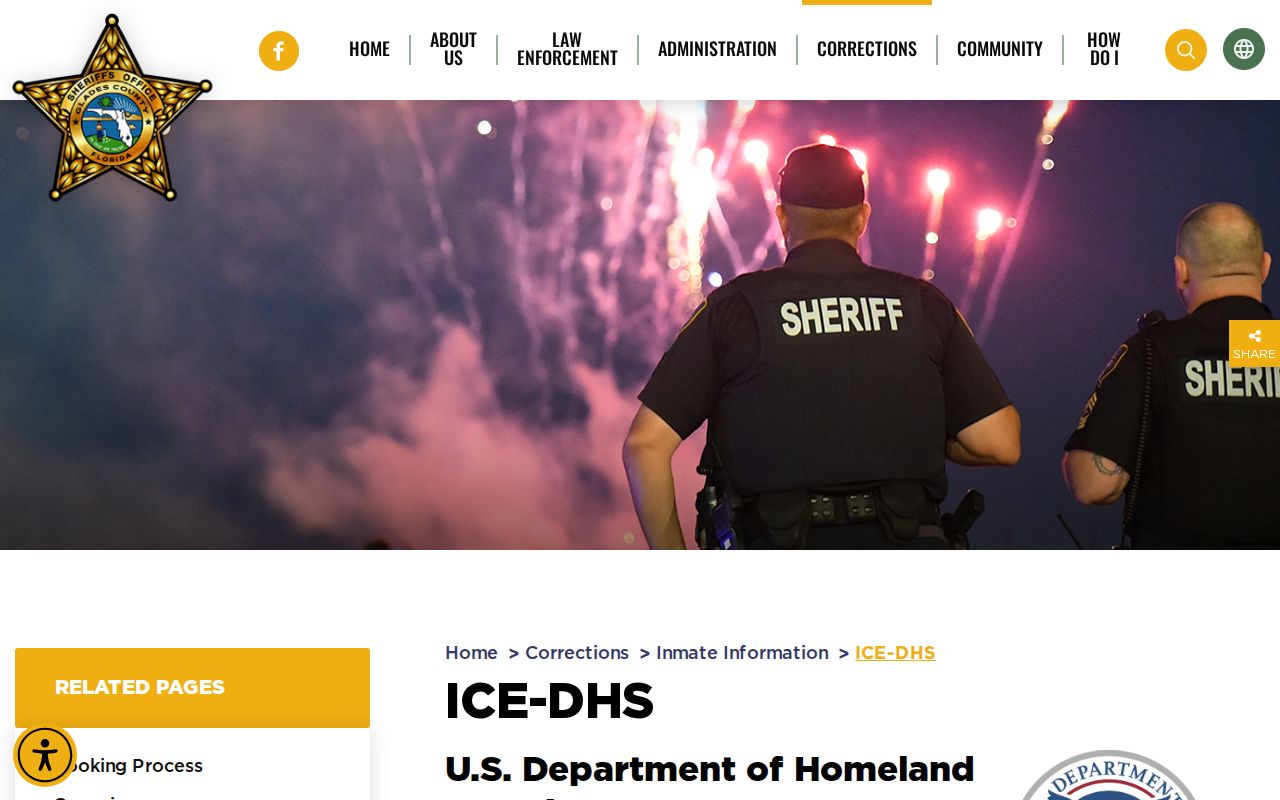
That county page is an access point to ICE information, while ICE remains the custodian of the immigration detention status.
Glades Federal Custody Boundaries
ICE, BOP, and USMS are separate federal custody systems. BOP's locator covers federal prisoners in Bureau custody and can report a release date or “Not in BOP custody.” It is not the ICE locator. USMS handles federal pretrial prisoners and may use local beds, but it has no public historical release locator equivalent to BOP and generally does not publish prisoner photographs or arrival and departure times.
A federal pretrial detainee who leaves a local-facing roster may require a federal court docket check. A person transferred after conviction into BOP should be followed in the BOP locator. An immigration detainee at Glades belongs in ODLS and the ICE contact route. A Florida state prisoner belongs in FDC. Geographic location does not merge those record systems.
For the county facility's local booking and release functions, use the Glades County Detention Center records page. For the ICE episode, keep the A-number, ODLS result, agency contact, and case record together. That division preserves the exact meaning of each custody status.