
Glades County Release Date Types
A projected date is an estimate calculated within a sentence. An actual release date records the completed custody event. Florida law uses the term tentative release date for the state gain-time calculation, while the public FDC detail uses the label Current Release Date. Both terms must remain distinct. A current date can move before release. A past date paired with released status and incarceration history is stronger evidence that FDC custody ended.
A pretrial detainee at the Glades County Detention Center is different. Until the court orders release, bond is posted, charges are resolved, or another custody event occurs, there is no sentence-based date to calculate. SmartWEB may show a booking and current status, but that does not create a scheduled release. Once the jail posts Status: Released and the exact Released: timestamp, the event becomes historical. The court docket then helps explain its legal basis.
Release from one building also may be a transfer. A person can leave the county jail for FDC, ICE, BOP, or another county. A state prisoner can leave Moore Haven Correctional and Rehabilitation Facility for another FDC institution without leaving state custody. The next locator must match the next agency.
Run a Glades County Release Lookup
The custody type sets the search order. Use the DC number when the person has an FDC record because it is more precise than a name. For a Glades County jail sentence, obtain the sentence and jail calculation instead of importing the state prison rules. For a pretrial booking, follow the court and bond history. The Glades County released-inmate search connects those source systems when the custody path is uncertain.
- Identify whether the person is in the county jail, Florida state prison, federal custody, ICE custody, or another local jail.
- For state prison, open the FDC Inmate Population Information Search and search by DC number or carefully matched name.
- Read the exact Current Release Date, current status, location, sentence history, county, and case fields. Note the page's “as of” date.
- For a Glades county-jail sentence, request the jail sentence calculation, credits, release record, and applicable Board of County Commissioners policy.
- Compare the court judgment, sentence, jail or prison credit, later orders, and any detainer information with the agency calculation.
- Recheck near the date and confirm the actual movement through the holding agency's release history.
The captured FDC offender-search landing form shows the statewide search entry used for a Florida prison record.
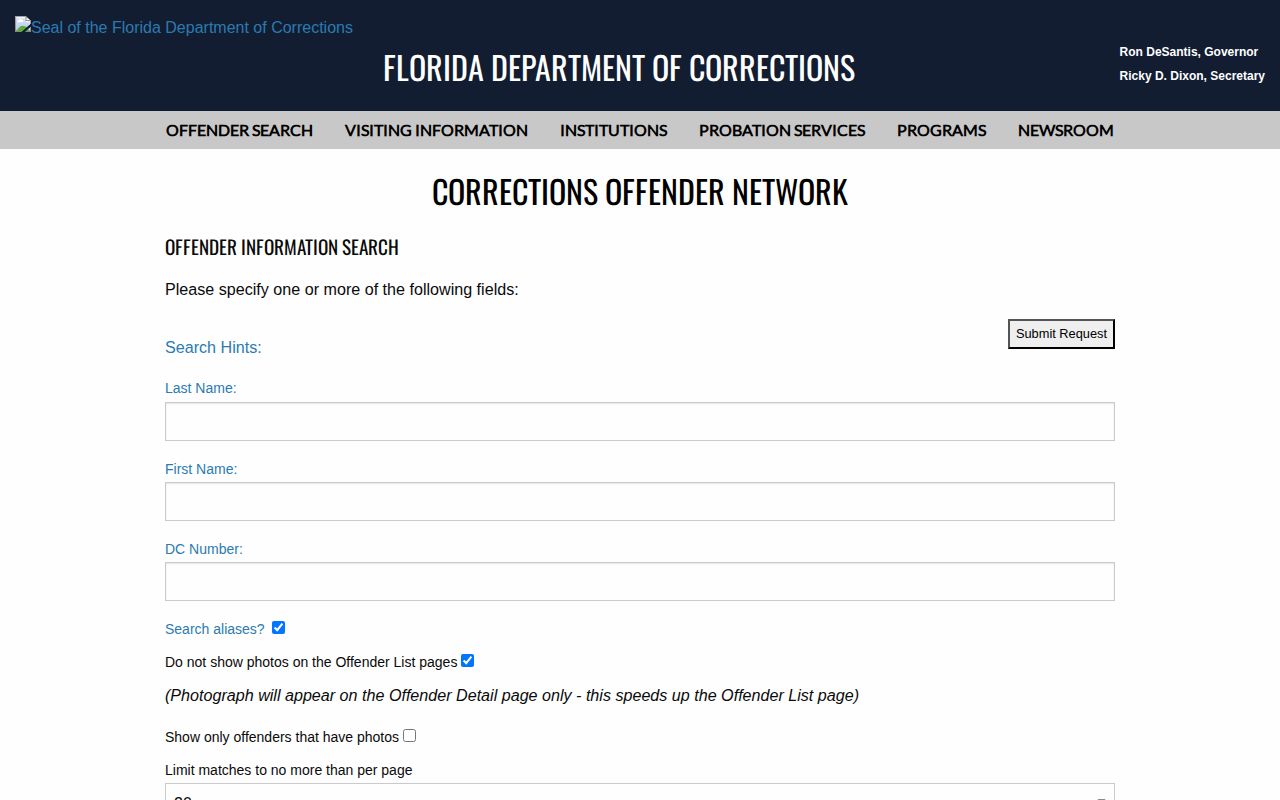
This is not the right database for every Glades County booking. A person held only by GCSO can have no FDC result at all.
Note: Search the system that holds the person; a county booking does not by itself create a Florida prison release date.
Glades County FDC Release Fields
FDC active population details combine present status with sentence data. The headline location can show whether the person remains in prison or has moved within the state system. Sentence history identifies the county, case, offense, sentence date, and term. The Current Release Date is the public expression of a calculation, not a promise. An official example captured for the manifest displayed that label on a finite-term active record, while a life-sentence example displayed “SENTENCED TO LIFE.”
| FDC field | Use in a release lookup |
|---|---|
| DC number | Provides the strongest key for matching one Florida offender record. |
| Current status and location | Distinguishes active custody, a facility transfer, and other FDC states. |
| Current Release Date | Displays the current projected date for an eligible finite term and can change. |
| Sentence history | Links county, case, offense, imposed term, and sentence dates to the calculation. |
| Detainer information | Shows an outside agency interest that may affect what happens after FDC release. |
| Incarceration history | Pairs past in-custody and out-custody events when a release is complete. |
The FDC search hub says population data receives a complete weekly refresh, while release-date and location changes update nightly. Even a recently refreshed date can change after a new order or credit action. Record the displayed date and the source update date together.
Florida State Release Computation
Florida Statutes § 944.275 requires FDC first to establish a maximum sentence expiration date for a term of years, reduced by lawful credit. Additional sentences imposed before release can extend that date, less lawful credit. Escape time, parole-violation time, and new terms can also affect it under the statute. The maximum expiration date is an outside sentence calculation. It is not always the expected exit day.
FDC then establishes the tentative release date. Eligible gain-time granted or restored can move it earlier. Forfeited gain-time can move it later. The tentative date cannot be later than the maximum expiration date. Offense date and statutory eligibility matter because Florida's gain-time rules changed over time. Basic gain-time of ten days per month applies only to the historical offense window stated in the law. Incentive-gain-time ceilings also vary across older and modern offense dates, with exclusions for some offenses and terms.
For people within the modern rule in § 944.275(4)(b)3, gain-time cannot produce release before at least 85 percent of the imposed sentence has been served, including court-awarded credit for time physically incarcerated. The 85-percent point is a floor, not an automatic release day. Mandatory minimums, ineligible offenses, disciplinary forfeiture, additional sentences, life terms, and other limits can push the date later.
The manifest image of Florida's tentative-release-date statute preserves the source language behind the calculation.
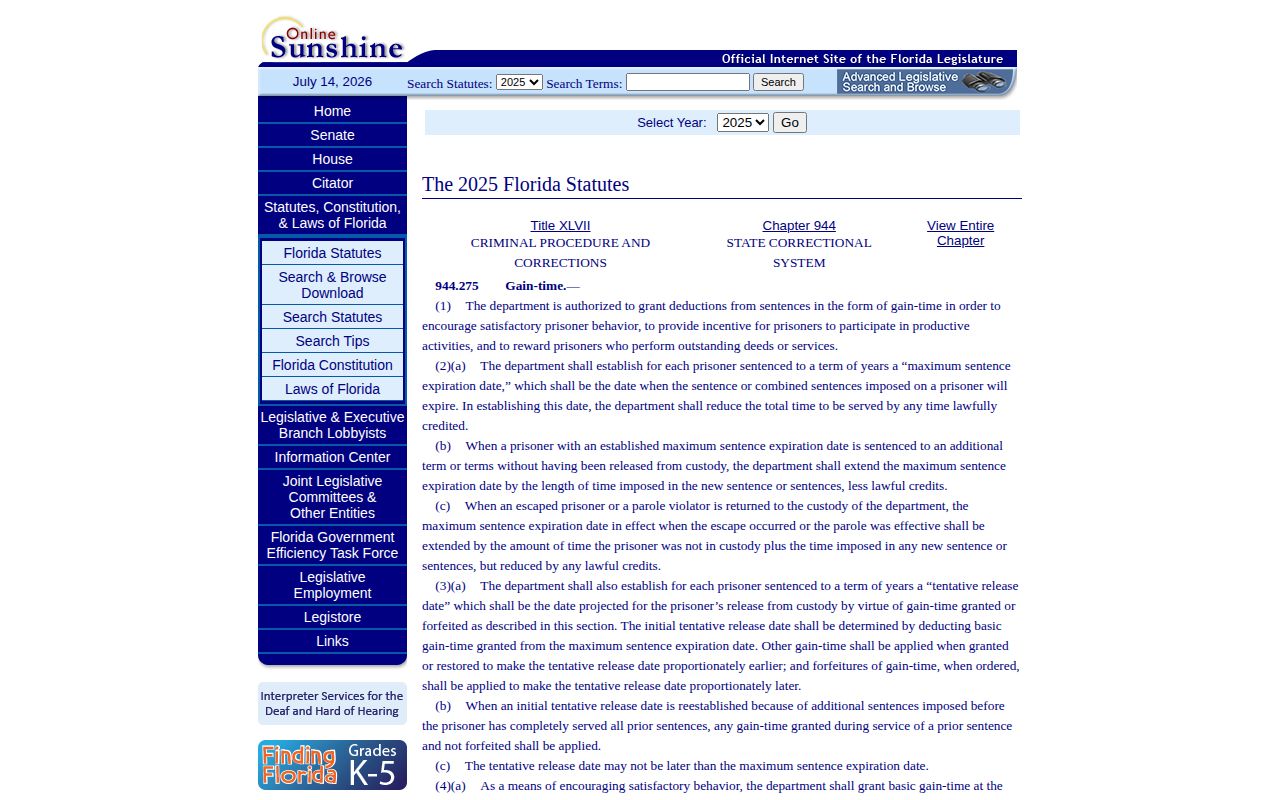
The statute's detail is why a simple online sentence calculator cannot establish one person's lawful Florida release date.
Glades County Jail Time Credits
A county-jail sentence follows a different statute. Florida Statutes § 951.21 says the board of county commissioners grants good-conduct commutation unless a majority elects to discontinue or revise the policy. Under the statutory schedule, when authorized, the deduction can be up to five days per month in years one and two, ten days per month in years three and four, and fifteen days per month in year five and later. The board may allow up to five more days per month for meritorious conduct or exceptional industry on recommendation. Misconduct can forfeit credit.
No Glades County policy document establishing the currently operative calculation was found. The statute expressly allows local revision. Do not subtract the maximum statutory allowance from a county sentence and publish the result as the Glades County release date. Ask GCSO for the actual jail computation, earned and forfeited credits, the policy applied, and the final release record.
Section 951.29 supplies a useful document clue for felony county prisoners. When possible, the administrator must provide restoration-of-civil-rights material and written notice of outstanding sentence terms before discharge, except when discharge is into FDC custody. That written statement may help reconcile sentence terms with a jail timestamp.
Note: The state prison gain-time formula and the Glades county-jail credit process are separate calculations governed by different sources.
Why Glades Release Dates Change
A date can move because the underlying inputs change. Some changes affect the number of days in custody. Others affect the next destination without changing the sentence end. The source record should show which agency made the change and which legal instrument supports it. A future date copied without that context can become stale overnight.
| Factor | Possible effect | Record to check |
|---|---|---|
| Gain-time award or restoration | May advance an eligible tentative date within statutory limits. | FDC sentence calculation and gain-time history |
| Disciplinary forfeiture | May move the tentative date later. | FDC disciplinary and sentence records |
| New or corrected sentence | Can add time or alter lawful jail credit. | Court judgment and amended orders |
| Mandatory or non-advanceable term | Prevents credits from moving the date past the controlling floor. | Sentence, statute, and FDC calculation |
| Detainer or outside hold | Can send the person to another agency when current custody ends. | Detainer field and receiving locator |
| FCOR-controlled action | May establish, modify, extend, delay, or revoke a Commission release date. | Final FCOR order, not just an agenda |
Florida Commission on Offender Review matters mainly concern older parole-eligible sentences and other Commission-controlled release types. An agenda is notice of a scheduled matter, not the final result. Obtain the final action or order and compare it with FDC status. Modern Florida sentences should not be casually described as parole cases.
Glades Release Computation Specifics
The distinctive-angle sweep found no official Glades County weekend or holiday release-computation rule. None should be invented. A sentence end near a weekend does not support an assumption that the jail will release early or late. Ask GCSO how the controlling order and local calculation are implemented for the named custody episode.
Florida administrative materials use “non-advanceable date” for dates constrained by modern tentative-release rules, a presumptive parole release date, or a requirement to serve a full minimum term. This reinforces the same point: credits cannot override every legal limit. The person's offense date, sentence, mandatory terms, credit history, and release authority all belong in the computation.
For a county record, contact GCSO at 863-946-1600 or request the existing sentence calculation through the Records Department. For a state release question, the FDC Bureau of Admission and Release lists 850-488-9167 and dc.release@fdc.myflorida.com. Ask for an official record rather than asking staff to create a new calculation narrative.
Confirm a Glades Release Date
Close to the displayed day, recheck the same source. For FDC, compare Current Release Date, status, location, detainers, and the record's update date. After the event, look for a released status and an out-custody date in incarceration history. For GCSO, select “Released Inmates Only” in SmartWEB and read the exact timestamp. Then check the Glades Clerk court portal for the bond order, sentence, disposition, or other legal event.
A pending alert can help, but it remains a signal rather than the release record. The Glades County VINE inmate check explains how to register and confirm phone, text, or email notifications. Use BOP for a federal sentence and ICE ODLS for immigration custody. No single county or state screen covers all those systems.
When the public result remains unclear, request the movement or discharge record from the agency that held the person. Include the full name, DC or booking number, birth date if known, institution, case number, and date range. A focused request helps the custodian locate an existing record and separates the projected calculation from the actual release event.