
Florida Release Record Boundaries
FDC records apply to a person sentenced to Florida prison or supervised by FDC Community Corrections. A person released only from Glades County Detention Center may have no FDC record. Conversely, someone can leave prison and remain under probation, conditional release, parole, or another supervision type. Physical release is not always full discharge.
| Search | Purpose |
|---|---|
| Active Inmate Population | Current prison status and location |
| Inmate Release Information | Released or scheduled-for-release records |
| Supervised Population | Community supervision after prison |
| Absconder/Fugitive | People unavailable for active supervision |
Confirm Florida State Release
Use Inmate Release Information. Search the six-character DC number for the best match, or use first and last name. Compare the photo, birth date, aliases, physical description, county, offense, and case.
- Open the matching detail and read current status.
- Compare Release Date with incarceration-history in-custody and out-custody dates.
- Review current prison sentence history and any listed detainer.
- Check Supervised Population for control continuing in the community.
- Request an official movement or discharge record if fields conflict.
A displayed future date is prospective. Florida law calls the calculated date a tentative release date because gain-time, forfeiture, a new sentence, mandatory minimum, detainer, or court action can alter it. A past date paired with released status is retrospective evidence.
The official release search is shown below.
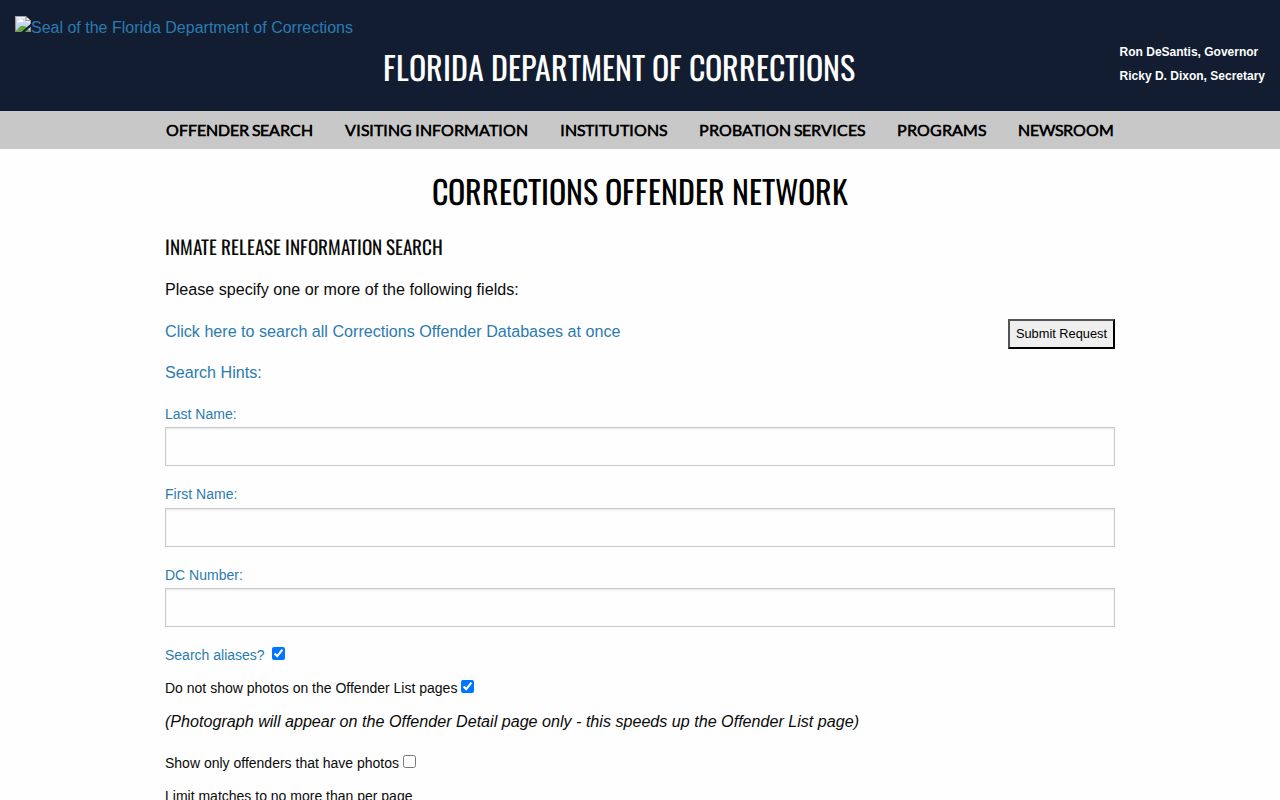
The form separates released and scheduled cases from active prison results.
Florida Discharge Record Fields
An FDC released detail can show a photograph, DC number, name, demographics, Release Date, aliases, sentence history, county and case number, detainers, and incarceration history. A residence on release may appear in some records but is not guaranteed. Offense labels may be shortened, so the court record and statute control the full legal description.
The official released-result capture shows the field arrangement.
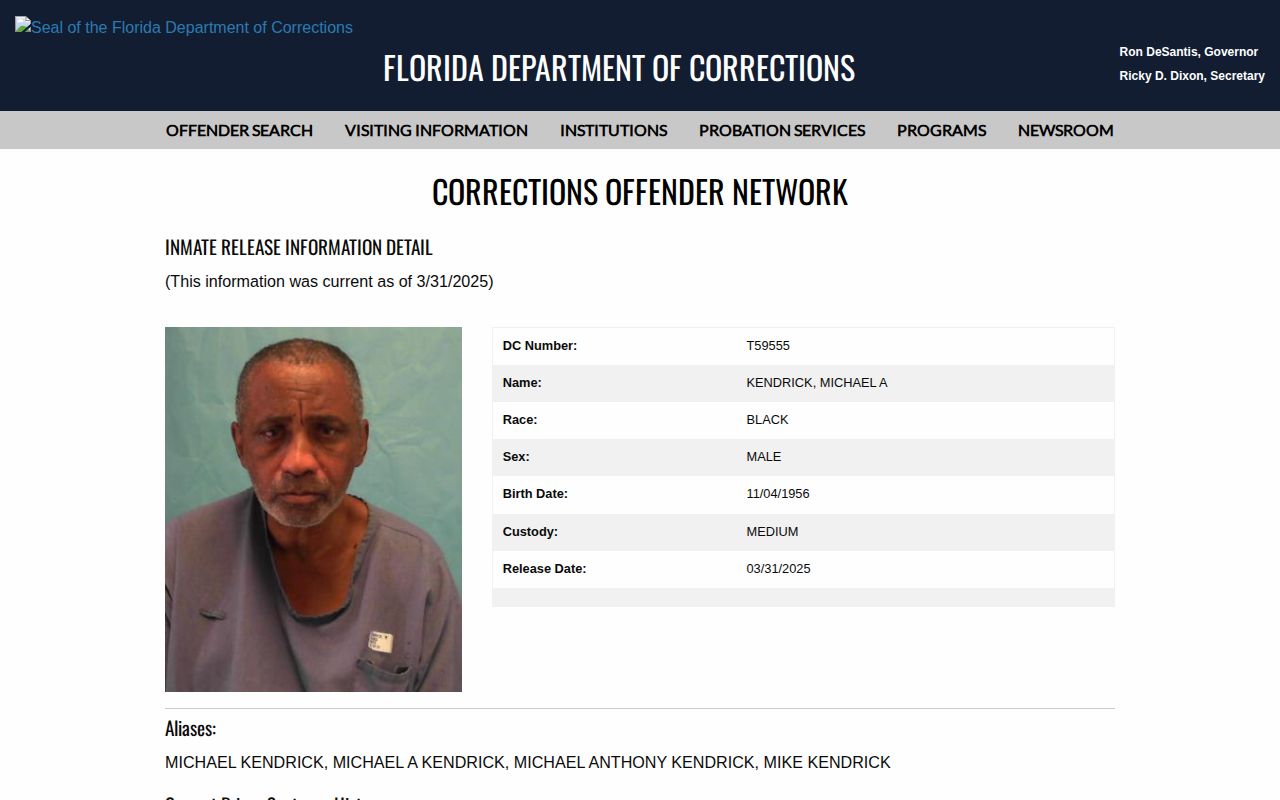
Out-custody history and release status should be read together rather than relying on one date.
Florida Release Records Contact
Use FDC Public Records for an official movement history, state release or discharge record, sentence data, or image missing from the public detail. Include full name, DC number, birth date if known, institution, and date range.
Phone: 850-488-9167
Email: dc.release@fdc.myflorida.com
Inmate Release Information updates nightly.
Active inmate classification questions go to the Bureau of Classification and Central Records at 850-488-9859 or central.classification@fdc.myflorida.com. Ask for a fee estimate before a large request.
Florida Release and Supervision
FDC Community Corrections supervises probation, parole, conditional release, and other state statuses. The public supervision detail may provide the supervision begin date, current location city, status, supervision type, scheduled termination date, verified address, aliases, and case history. Its full database refreshes weekly, while termination dates and location changes update nightly.
Parole is not a generic term for all Florida prison release. It mainly concerns older parole-eligible sentences and narrow statutory categories. Use the exact FDC or Florida Commission on Offender Review wording. A supervision end date, not the prison exit alone, helps show when correctional control is discharged.
Glades and State Custody
Moore Haven Correctional and Rehabilitation Facility is a state-contract prison, so FDC is its individual record path. Glades County SmartWEB covers the separate county jail episode. A person may appear in both systems in sequence, especially after a county-to-state transfer, but a release entry in one does not prove release from the other.
Florida Tentative Release Dates
Section 944.275 requires FDC to establish a tentative release date for a prisoner serving a term of years. The calculation reflects eligible gain-time granted, restored, or forfeited and cannot fall after maximum sentence expiration. The public detail may use Current Release Date, but that wording does not make it fixed. A disciplinary loss, new sentence, detainer, mandatory minimum, or another legal constraint may move actual departure later.
For qualifying modern offenses, gain-time cannot result in release before at least 85 percent of the imposed sentence has been served, counting qualifying court-awarded credit. That percentage is a minimum service rule, not an automatic release promise. Life terms, excluded offenses, and other limits require different treatment. A date copied while the person remains active must stay labeled prospective.
A completed state release is better shown by matching fields: released status, a past Release Date, and incarceration history with an out-custody date. A detainer can show another agency's interest but may not explain the final destination. When fields conflict, request the official FDC movement history and compare the sentencing court docket.
Florida Release Record Requests
A focused public-record request should identify the existing item needed: release or discharge record, movement history, sentence calculation, detainer entry, image, or supervision termination record. Give the DC number, full name, birth date if known, institution, and date range. FDC answers state custody. The court answers the judgment and legal basis, while GCSO answers its own county movement.
Florida Chapter 119 generally requires prompt acknowledgement and good-faith production, subject to retrieval, review, redaction, exemptions, and authorized charges. It sets no universal fixed response time for every request. Ask for electronic delivery and a cost estimate. If material is withheld, request the statutory basis and any nonexempt portions that can be separated.
A custodian supplies existing records rather than creating a new explanation. Phrase the request around named documents and dates. That approach also avoids mixing an FDC discharge with the reason a person may have left Glades County jail before state commitment.
Florida Release Status Terms
State corrections labels are not interchangeable. Transfer means movement within custody. Release means departure from the recorded prison or custody episode. Conditional release is a statutory form of supervision. Parole applies mainly to older or specially eligible Florida sentences. Probation is court-ordered supervision, and discharge marks the end of the applicable correctional obligation.
- DC number
- FDC's six-character identifier and strongest public search key.
- Gain-time
- Eligible sentence credit governed by statute and FDC calculation.
- Detainer
- Another agency's request or notice affecting what follows custody.
- Absconder
- A supervised person alleged to have stopped making themselves available.
Someone can appear in the separate Absconder/Fugitive Search after a valid prison release. That later status does not erase the prior release. It describes an alleged supervision issue. Compare dates and agency records before stating the sequence.
Florida Release Database Updates
FDC says Inmate Release Information updates nightly. Active inmate and supervised population databases receive full weekly refreshes, while specified release dates, termination dates, and location changes update nightly. Those schedules explain why two state screens can briefly differ. They also prevent a sound claim that the public record is instantaneous.
VINE may send a custody-change alert for a participating Florida agency, but it is not a certified discharge record. Compare the alert with FDC and, when needed, the Bureau of Admission and Release. BOP and ICE keep separate federal systems. A prior Glades County episode does not bring a federal record into FDC's scope.
Note: Database refresh timing can explain a short mismatch, but an official record request resolves a lasting conflict.
Florida Release Court Verification
The FDC detail proves the state correctional event, while the court file supplies the judgment and legal case history. Use the county and case number in sentence history to find the sentencing docket. Compare sentence dates, jail credit, later amended orders, and any supervision terms. A shortened FDC offense label should never replace the full court charge and disposition.
This division of records matters for Glades County. A GCSO release can precede transfer into FDC, and an FDC release can be followed by supervision. The county timestamp, state movement history, and court order may all be necessary to describe the full sequence without collapsing separate custody systems.
For a past event, preserve the status and date as the source displays them. For a future date, state that it is projected. If the court and FDC records remain inconsistent, request the certified court order and official FDC release or movement record before drawing a conclusion.