
Glades County Supervision Types
Parole and probation are not the same legal status. Parole is a Commission-controlled release from a prison term for the limited group of Florida prisoners who remain eligible under older laws or special categories. Florida largely ended ordinary parole eligibility for offenses committed on or after October 1, 1983. Probation is a court-ordered term served in the community. It may follow a jail or prison term, or the court may impose it without a prison release. Conditional release is another distinct state status for certain qualifying prisoners. The exact label in the official record controls.
Adult state supervision is administered in the field by the Florida Department of Corrections Community Corrections. The Florida Commission on Offender Review makes decisions in parole and other Commission matters. A Glades County sentence does not always mean a Glades office supervises the person. Field routing normally follows the approved place of residence.
| Status | Who sets it | Best verification path |
|---|---|---|
| Parole | Florida Commission on Offender Review | FDC supervised record plus the Commission action or order |
| Felony probation | Sentencing court | FDC Supervised Population record and court docket |
| Conditional release | Commission under Florida law | FDC status plus FCOR record |
| Misdemeanor probation | County court | Twentieth Circuit program and Glades court case |
| Juvenile aftercare | Juvenile court and DJJ | Authorized DJJ and juvenile-court channels |
- Parole
- Conditional community release for a person who is legally parole eligible.
- Probation
- Court-ordered community supervision with stated terms and an end date.
- Discharge
- The formal end of a custody or supervision obligation.
- Absconder
- A supervised person alleged to have stopped reporting or made their location unknown.
Check Glades County Post-Release Status
The public starting point is the FDC Supervised Population Search. It is built for people currently under state community supervision. The detail can show a photograph, DC number, demographics, supervision begin date, current location city, current status, supervision type, scheduled termination date, verified address, aliases, and case history. FDC says the database receives a full weekly refresh, while termination dates and location changes update nightly. That schedule calls for care when a court or officer has acted very recently.
- Search by the six-character DC number when it is known. Otherwise, enter the full legal name and compare all identifiers.
- Open the matching detail and read the current status, supervision type, begin date, location, and scheduled termination date.
- Match the county and case number to the Glades court record. Do not rely on the photo or name by itself.
- Use the FDC circuit and regional office map to find the office tied to the current location, not merely the sentencing county.
- For a Commission release type, locate the FCOR agenda and request the final action or order. An agenda is not the result.
- If the record flags absconder or fugitive status, use the separate FDC search and confirm current information with the responsible agency.
The official supervised-population screen shows the fields and search scope used for this check.
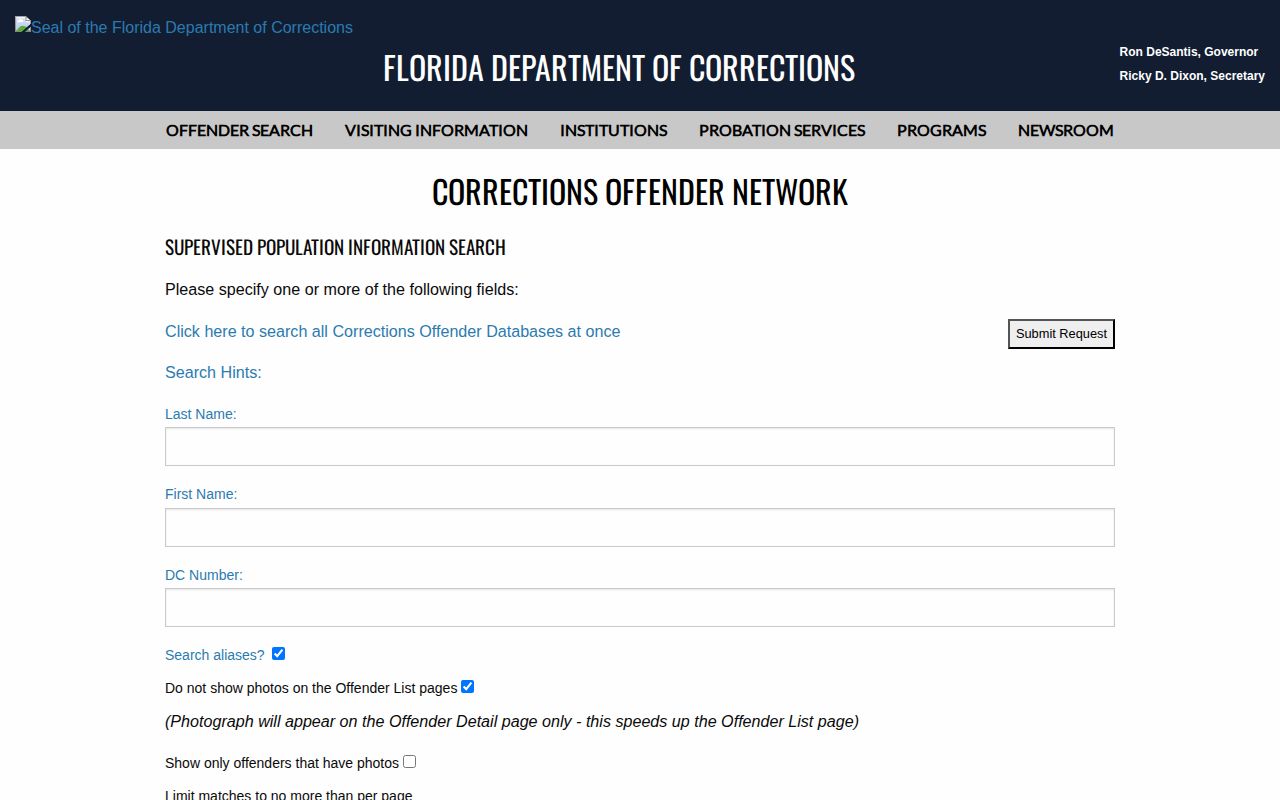
This state screen is the correct route for adult felony supervision, while the county jail roster only proves a local custody episode.
Note: A scheduled termination date is prospective until the official record shows that supervision has ended.
Glades County Supervision Contacts
FDC Probation and Parole Field Services routes adult felony cases. Its public contact is 850-717-3444 and co-supervision@fdc.myflorida.com. The FDC office map should be used with the person’s DC number and current location. No single local office can be assumed from a Glades conviction because a person may live and report in another circuit after release.
Adult felony supervision
FDC Probation and Parole Field Services
Phone: 850-717-3444
Email:
co-supervision@fdc.myflorida.com
Routing:
current-location office in the FDC directory
Glades misdemeanor and criminal-traffic probation follows a different path. The Twentieth Circuit program is at 500 Avenue J in Moore Haven. Its phone is 863-946-6032. Published hours are Monday through Friday, 8:30 a.m. to 5 p.m., with lunch from noon to 1 p.m. and closure on court holidays. The court docket identifies the case and any probation order. It should be checked with the program record.
Local misdemeanor probation
Twentieth Circuit Court Administration
500 Avenue J
Moore Haven, FL 33471
Phone:
863-946-6032
Hours: Monday through Friday, 8:30 a.m. to 5
p.m.; closed noon to 1 p.m.
Glades County Reentry Paths
Glades County has several post-release routes, not one general reentry office. Adult felony probation, parole, and conditional release belong in FDC systems. Misdemeanor probation is handled through the Twentieth Circuit program. Youth released from secure detention may return to a guardian, move to placement, or enter DJJ probation or aftercare. The Glades County Probation and Community Intervention Program serves Circuit 20 youth with screening, intake, diversion, probation, and aftercare links.
Moore Haven Correctional and Rehabilitation Facility has also hosted a release-planning seminar with community organizations. That local program history shows why a prison release and field supervision should be traced as separate events. Departure from the institution is shown in FDC custody data. A continuing supervision term is shown in the community record. A full discharge requires an end-status or formal record, not an assumption based on physical release.
Glades County Parole Decisions
When the record says parole or another Commission-controlled release, check the FCOR interactive voting schedule. A dated agenda can identify the person, DC number, county, offense, case, meeting, and category. It only proves that the matter was set for review. It does not prove that release was granted, denied, delayed, changed, or revoked.
The reliable result is the final Commission action, order, or minutes. Request it through the FCOR public-record process using the name, DC number, meeting date, and case. Then compare that order with the FDC Inmate Release search and current supervised-population detail. This sequence keeps the decision, actual prison departure, and present field status separate.
Note: Modern Florida prison release is often not parole, so use the exact FDC or FCOR release label.
Glades County Supervision Conditions
Conditions come from the controlling court order, Commission order, and supervision record. They are not supplied by the old jail booking entry. A public FDC detail can identify the type and term, but it may not reproduce every instruction given to the person. The court docket is the stronger source for probation terms. A Commission order controls parole or conditional-release requirements within its authority. When the wording matters, request the actual order instead of relying on a short status label.
A claimed violation also requires its own record trail. An officer’s allegation can lead to a warrant, hearing, court order, or Commission action. Those stages are not interchangeable. The first allegation does not by itself prove revocation, and a warrant does not show the final outcome. Compare the FDC status with the Glades case docket or FCOR action. If custody begins again, the receiving jail or prison record should show the new episode.
Supervision can also change location. FDC field routing follows where the person is approved to live and report, which may be outside Glades County. The state office map and current-location field are therefore more reliable than calling the sentencing county alone. For a recent change, ask the listed office to confirm public routing because the database refresh may trail the field action.
Glades County Absconder Checks
A release can be valid even when a later warrant exists. Absconder status generally means a supervised person allegedly stopped reporting or could no longer be located. It does not erase the earlier custody release. A warrant can lead to arrest and a violation or revocation proceeding, but the current warrant and final result must be checked in their own records.
Use the FDC Absconder and Fugitive Search for state supervision. FDC publishes 850-717-3475 for Absconder Unit routing on weekdays from 8 a.m. to 5 p.m. The GCSO Most Wanted page is a separate local list. Some entries may carry old added dates, so call the sheriff at 863-946-1600 before treating an item as current.
The official FDC absconder page visually separates that search from the ordinary supervised-population lookup.
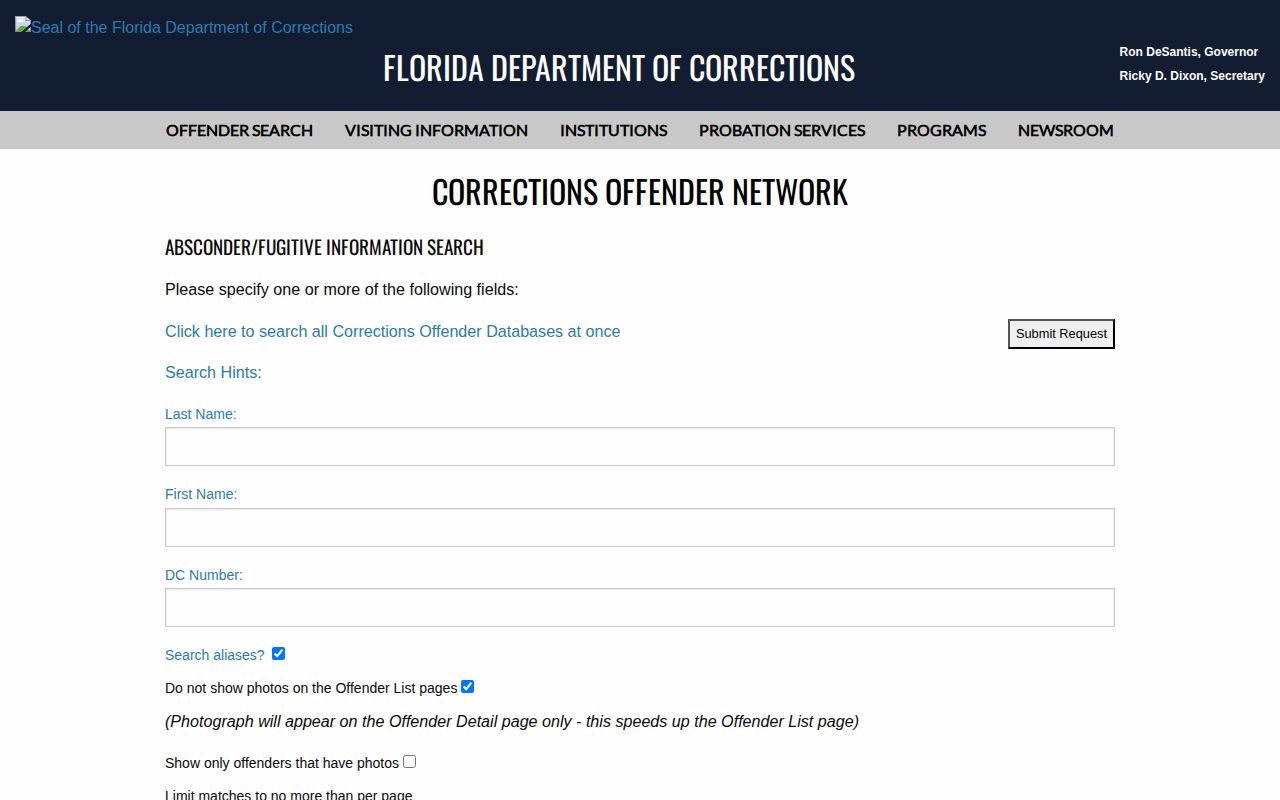
That separation matters because active supervision and alleged absconding are different public statuses.
Glades County Supervision Discharge
Supervision ends through the authority that imposed or controls it. A probation term may end on the scheduled date, by a court order, or after another lawful action. A Commission release can require a Commission record. FDC’s status and termination fields help show the state record, but a planned date is not the same as a completed discharge. Court termination orders and final agency records provide stronger proof.
Use the case number to connect the supervision record to the Glades court docket. For certified proof, request the termination or discharge order from the Clerk, or request the applicable state record from FDC or FCOR. The full county release and record trail is explained on the Glades County released inmates search. It separates the jail timestamp from the case result and any later supervision.
Release from custody and discharge from supervision are separate events. Confirm both when correctional control may continue.